


Titanium Dioxide Flocculation in Coatings: Causes, Tests, and Corrective Actions starts with one practical rule: evaluate the pigment inside the complete production formulation, not from TiO2 assay or a single supplier value. titanium dioxide flocculation performance depends on the pigment surface, formulation chemistry, dispersion process, film structure, and end-use requirement. A controlled trial should connect those variables to hiding, appearance, processing, durability, and cost.
Table Of Contents
- Why the formulation changes the result
- What formulators should compare
- A controlled laboratory workflow
- How to diagnose weak results
- Supplier qualification checklist
- Frequently asked questions
Titanium Dioxide Selection Priorities For Coatings
In coatings, titanium dioxide selection affects hiding power, whiteness, undertone, gloss, dispersion, heat stability, weather resistance, and batch consistency. A useful supplier discussion should connect rutile or anatase grade selection, surface treatment, particle size, oil absorption, and processing conditions to the customer’s finished product target.
Longtai writes this guide from a manufacturer and chemical application perspective. If you are reviewing titanium dioxide flocculation in coatings, the important question is whether the material can meet your quality standard in production, including the same resin, binder, filler package, temperature, shear level, and final inspection method used by your plant.
For faster technical support, share your application, current material issue, target whiteness or shade, processing method, dosage range, and required documents such as TDS, SDS, or COA. Longtai can then recommend a focused sample direction from the relevant titanium dioxide product range.
Why Causes, Tests, And Corrective Actions Changes Pigment Performance
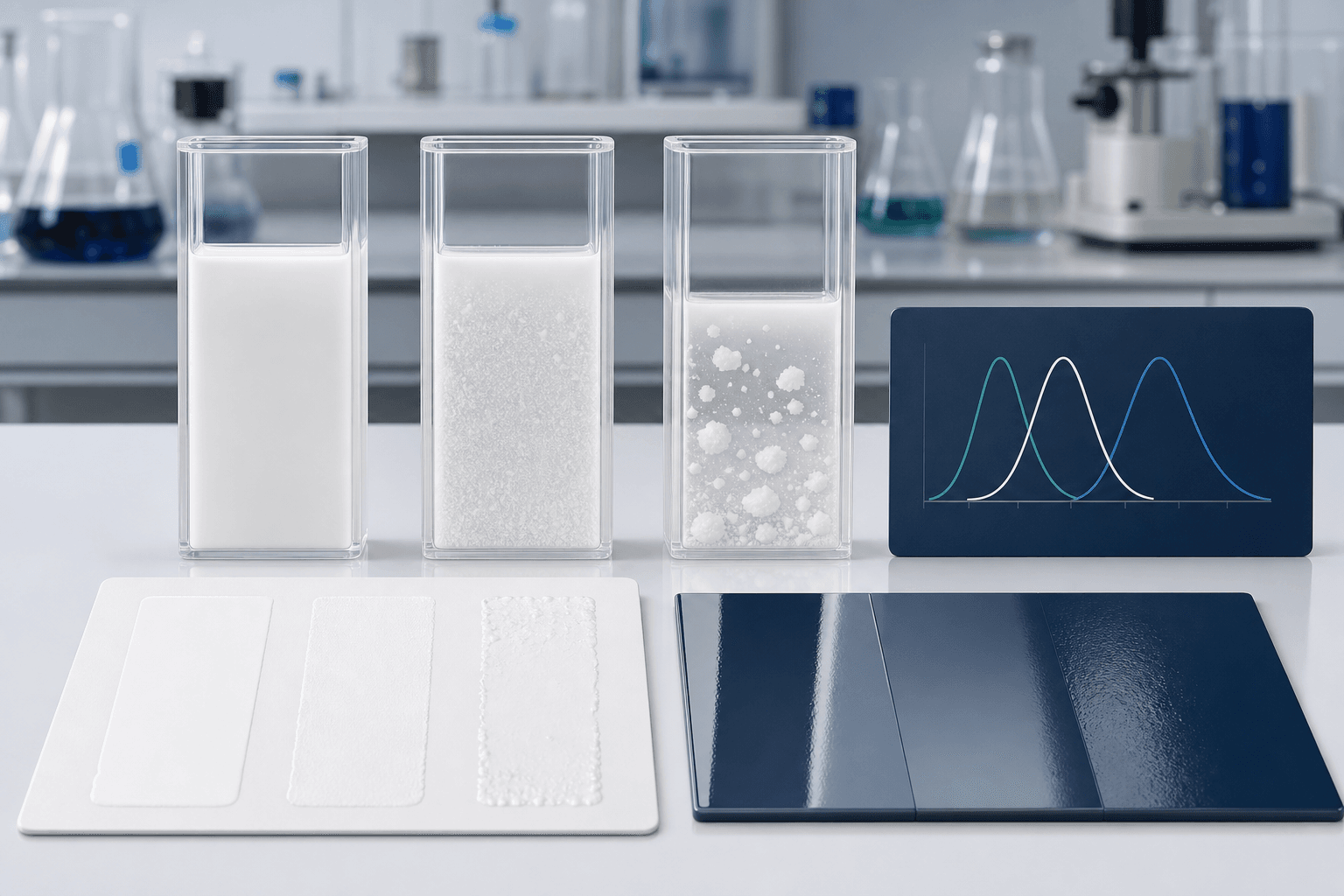
Flocculation occurs when dispersed pigment particles form loose, reversible networks because attractive forces exceed steric or electrostatic stabilization. Binder adsorption, dispersant deficiency or excess, electrolyte contamination, pH drift, and incompatible additives can trigger the change.
For this reason, titanium dioxide flocculation should be treated as a formulation-and-process decision. The grind gauge may show no hard agglomerates while the coating still loses gloss, tint strength, color uniformity, and hiding. This makes flocculation easy to misdiagnose as a pigment particle-size problem. The useful question is not whether one certificate number is higher, but whether the candidate creates a stable, reproducible coating within the plant’s operating limits.
What To Compare Before Approving Titanium Dioxide Flocculation
Use rub-up tests, viscosity response, tint-strength development, gloss, drawdown uniformity, microscopy or particle analysis, and storage aging. Test before and after letdown because many interactions appear only after binder or thickener addition. This prevents a stronger result from being created by a hidden change in the test rather than by the pigment.
| Decision area | Measure | Why it matters |
|---|---|---|
| Dispersant level, pH, and additive order | Rub-up, viscosity, gloss, tint strength | Distinguishes flocs from hard agglomerates |
| Dispersion quality | Fineness, residue, energy, temperature | Separates process limits from pigment behavior |
| Dry-film efficiency | Contrast ratio, tint strength, gloss | Shows useful optical performance at controlled film build |
| Robustness | Storage aging and repeat batches | Checks whether the result is stable and reproducible |
Use supplier data to define the starting window, then verify titanium dioxide flocculation with your own raw materials. Laser-diffraction results should be interpreted under a declared method because ISO 13320 describes method-dependent equivalent-sphere distributions. A grind gauge, covered by ASTM D1210, measures coarse particles or agglomerates in a dispersion; it does not replace an optical-performance test.
A Controlled Titanium Dioxide Flocculation Laboratory Workflow
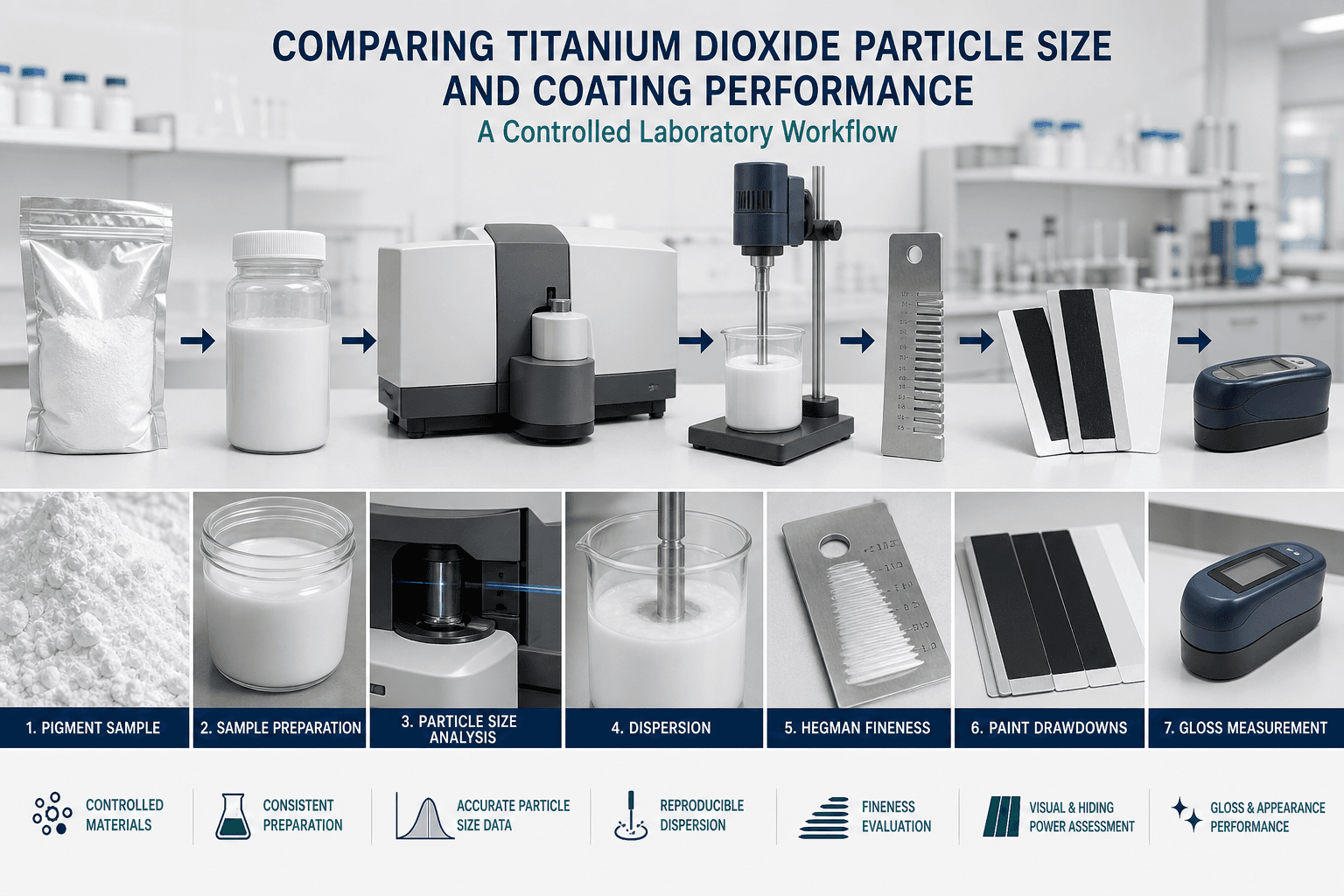
Run a dispersant ladder with controlled charging order and fixed shear. Compare the base immediately, after letdown, and after heat aging. A reversible color or gloss change under rubbing is strong evidence of flocculation. Randomize sample order where practical and repeat the control so drift in mixing, application, or measurement becomes visible.
- Define the pass/fail limits before opening the samples.
- Condition raw materials and panels at the same temperature.
- Record charging order, speed, time, batch temperature, and energy.
- Test the mill base before completing the letdown.
- Apply equal wet or dry film thickness and use the same cure schedule.
- Repeat critical measurements and retain labeled samples.
How To Diagnose Disappointing Titanium Dioxide Flocculation Results
More dispersant is not always corrective. Overdosing can displace binder, create foam, harm water resistance, or destabilize other pigments. Confirm the stable dosage window and check pH and electrolyte sources. Change one variable at a time and preserve the original control. Otherwise, simultaneous changes to dispersant, shear, binder, and pigment loading make the cause impossible to identify.
Separate dispersion from optical crowding
If fineness improves but hiding does not, check film thickness, pigment volume concentration, extender spacing, and refractive-index contrast. If tint strength or gloss changes after a rub-up or after letdown, investigate flocculation. This distinction keeps a titanium dioxide flocculation project from becoming an endless increase in milling time.
Calculate delivered value
Compare cost at the dosage that actually passes, including dispersion time, yield loss, solvent or water adjustment, and rework risk. The cheapest price per tonne is not necessarily the lowest cost per passing litre of paint. A stable titanium dioxide flocculation grade can create value through higher throughput and fewer corrections even when its invoice price is higher.
Titanium Dioxide Flocculation Supplier Qualification Checklist
Request surface-treatment chemistry, recommended dispersant families, compatible binder examples, pH guidance, and application evidence that includes aged rather than only fresh paint. Also confirm specification limits, test methods, change-notification practice, certificate availability, traceability, packaging, lead time, and technical support.
- Match the grade to binder, process, sheen, and exposure.
- Request test methods, not only typical values.
- Trial more than one production lot before full approval.
- Keep an approved control and retained samples.
- Set incoming checks around properties that predict plant performance.
Longtai supplies rutile titanium dioxide for coatings and supports application-based grade screening. Review the titanium dioxide product range, then use our guides to test TiO2 dispersibility and understand titanium dioxide quality inspection.
Frequently Asked Questions
Can a TDS select the best grade?
No. A TDS is useful for screening, but titanium dioxide flocculation must be verified in the target formulation because binder, additives, shear, pigment volume concentration, and film build affect the result.
Should candidates use the same dispersant dose?
Use one fixed-dose comparison to expose sensitivity, then optimize promising candidates separately. Different pigment surfaces can have different stable dosage windows, and an unfair dose can reject a suitable grade.
How many lots should be approved?
Evaluate multiple representative lots when supply risk matters. One laboratory sample demonstrates potential; repeated lots show whether titanium dioxide flocculation remains inside the process and performance window.
Need a grade recommendation? Contact Longtai with your binder, formulation type, application method, target properties, and current control grade. We can recommend a starting sample and a practical comparison plan.
Method references: ISO 13320:2020, Particle size analysis 鈥?Laser diffraction methods; ASTM paint and coating standards, including D1210.