


How to Qualify a Titanium Dioxide Grade on a Plastic Extrusion Line is best evaluated as an application system, not as a contest between isolated certificate values. For plastics compounders, masterbatch producers, and converters, Titanium Dioxide Grade on a Plastic Extrusion Line means matching material properties to the actual formulation, process window, finished-product target, and supply risk. The practical goal is repeatable performance at the lowest delivered cost, not simply the highest number on a technical data sheet.
What Determines Titanium Dioxide Performance On A Plastic Extrusion Line?
The decisive interface is between the supplied material and the customer’s complete system. In plastics, the important variables include polymer grade, carrier resin, stabilizers, lubricants, filler package, screw design, temperature profile, and let-down ratio. Changing any one of them can alter wetting, distribution, optical efficiency, flow, surface appearance, or durability. A grade that works in one line is therefore not automatically interchangeable with a grade that has a similar assay.
A useful the TiO2 grade review separates three questions. First, can the material be incorporated without disrupting throughput? Second, does it deliver the required appearance and functional performance at a controlled dosage? Third, does that result remain stable after storage, conversion, and end-use exposure? This sequence prevents a good initial sample from bypassing process and durability risks.
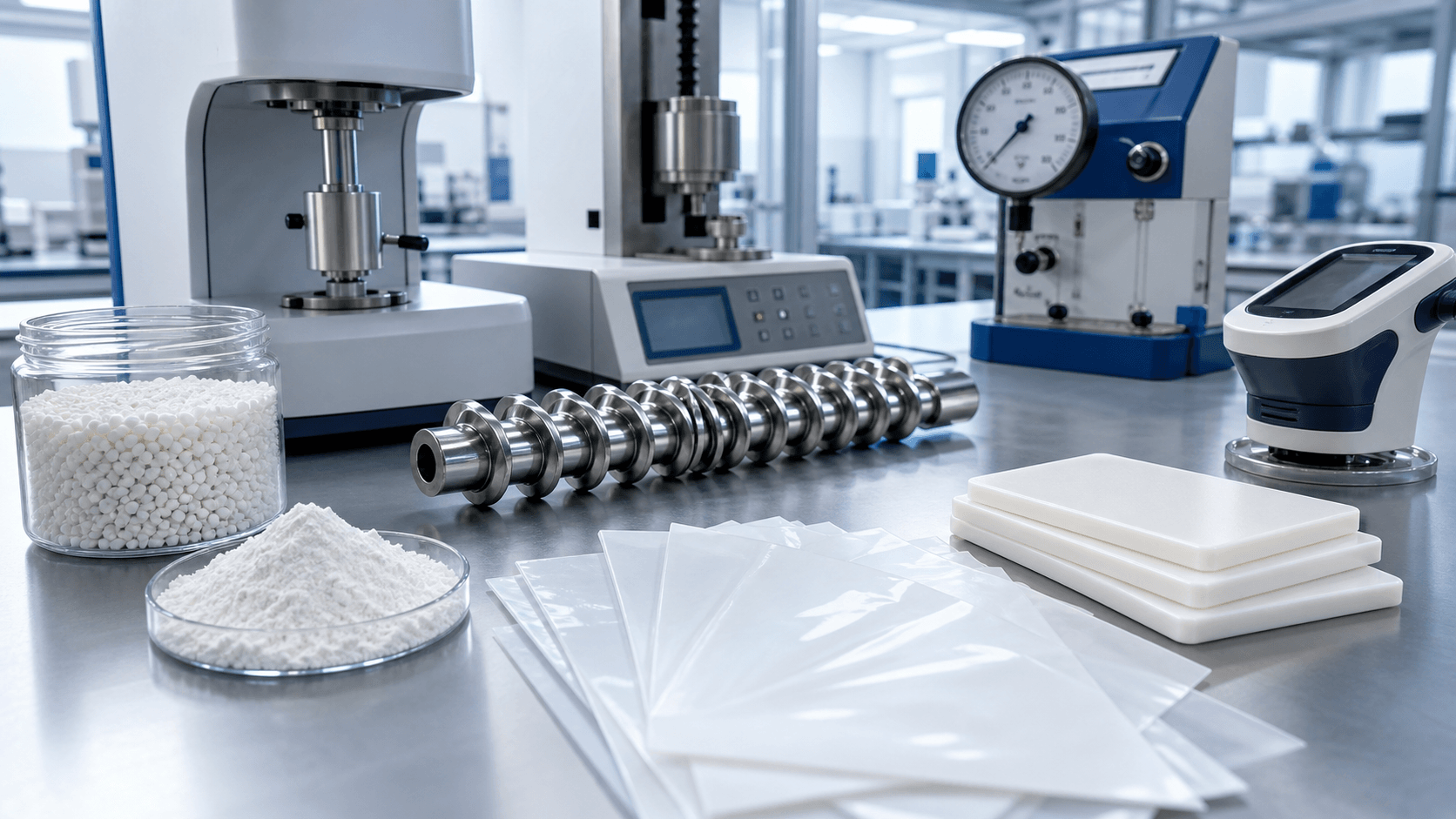
Hold Test Variables Constant
Write the test recipe before opening samples. Fix raw-material lots, addition order, batch size, equipment geometry, speed, time, temperature, conditioning, application or conversion settings, and measurement method. Record deviations. Without those controls, normal laboratory variation can look like a meaningful the selected grade difference.
Use an accepted production material as the control and include at least two representative lots when supply consistency is important. Compare candidates at equal addition first, then optimize the most promising option around its recommended processing or dispersant window. A fixed recipe exposes sensitivity; an optimized comparison reveals achievable value.
How To Investigate Die Build-Up, Specks, Or Shade Drift
Typical warning signs include plate-out, die build-up, filter pressure rise, streaks, poor opacity, or loss of processing stability. Start by comparing the failing sample with the retained control under the same method. Then separate raw-material variation from formulation, equipment, environment, and measurement causes. Change one variable at a time; otherwise a successful correction will not reveal the real cause.
If Dispersion Or Distribution Is Weak
Check charging order, wetting time, shear or mixing energy, temperature, moisture, dispersant compatibility, and the condition of screens or filters. More energy is not always the answer: excessive heat or residence time can damage the polymer, binder, additive, or surface treatment. Establish the stable the candidate pigment processing window experimentally.
If Appearance Passes But Durability Fails
Review surface chemistry, stabilizer or binder protection, exposure conditions, specimen preparation, and film or part thickness. Initial whiteness and opacity are screening properties; they do not by themselves prove weathering, heat stability, adhesion, filtration behavior, or long-term mechanical integrity.
Supplier Qualification Checklist For Plastic Extrusion
- Request a current specification and the method behind every acceptance value.
- Confirm the recommended application, processing window, dosage, and incompatible systems.
- Compare multiple production lots and keep approved retained samples.
- Define packaging, moisture protection, traceability, shelf life, and change notification.
- Calculate cost at the dosage and process conditions that actually pass.
- Agree on complaint evidence, response timing, and corrective-action expectations.
For buyers comparing titanium dioxide for plastic extrusion, the real test is how the grade behaves in the finished polymer, not in a loose powder check.
Longtai reviews titanium dioxide for plastic extrusion in the same extrusion or molding window the buyer uses in production, because surface finish and color control depend on the real process.
Manufacturer Perspective
As a titanium dioxide manufacturer, Longtai treats titanium dioxide for plastic extrusion as a production decision, not a catalog choice.
That means the buyer should compare the sample in the same mixing, coating, extrusion, or curing window used in production.
For a neutral chemical identity reference, PubChem’s titanium dioxide record is useful, but grade approval still depends on the buyer’s own trial and inspection standard. PubChem titanium dioxide record
What Buyers Should Send Before Requesting A Sample
- Use the buyer’s actual binder, filler package, and target loading.
- Check opacity, gloss, shade, dispersion, and process stability in the plant’s normal window.
- Keep the approved sample, lot number, and evaluation notes together for repeat orders.
titanium dioxide for plastic extrusion should always be tested against the buyer’s real formula, not a loose sample standard. The right sample request gives Longtai enough context to recommend a practical starting point.
Talk To Longtai About A Suitable Grade
If you are comparing titanium dioxide for plastic extrusion, send Longtai your application, formulation type, processing conditions, target performance, and required documents. Our team can review the technical fit from a manufacturer and chemical application perspective, then suggest a practical sample direction.
For faster support, include your current material issue, approved standard, expected packaging, and destination market when you contact Longtai.
Summary
The final approval for titanium dioxide for plastic extrusion should come from the buyer’s real process window, not from a catalog description. The safest choice is the grade that matches the current standard, the production setup, and the repeat-order path already used in the plant.
Practical Buying Checklist
- When buyers review titanium dioxide for plastic extrusion for plastics, the real decision happens after extrusion or molding, not in the powder jar. The part surface, color, and dispersion tell the more useful story.
- A good trial should keep temperature, screw speed, and additive package consistent. That lets the team see whether titanium dioxide for plastic extrusion is actually stable or whether the process is hiding a weakness.
- Repeat lots matter because a plastic buyer is not only trying to pass one sample. The goal is to keep the same visual result and processing behavior the next time the material is ordered.
- If the current grade creates specks, streaks, or shade drift, the buyer should compare it against a retained standard under the same production setting. That makes the next choice easier to justify.
- Before approving titanium dioxide for plastic extrusion, compare the sample with the retained standard under the same test conditions used by production.
- For repeat orders, record the approved application window alongside the lot information so the next titanium dioxide for plastic extrusion review starts from a known reference.
Practical Buying Checklist
- When buyers review titanium dioxide for plastic extrusion for plastics, the real decision happens after extrusion or molding, not in the powder jar. The part surface, color, and dispersion tell the more useful story.
- A good trial should keep temperature, screw speed, and additive package consistent. That lets the team see whether titanium dioxide for plastic extrusion is actually stable or whether the process is hiding a weakness.
- Repeat lots matter because a plastic buyer is not only trying to pass one sample. The goal is to keep the same visual result and processing behavior the next time the material is ordered.
- If the current grade creates specks, streaks, or shade drift, the buyer should compare it against a retained standard under the same production setting. That makes the next choice easier to justify.
- Before approving titanium dioxide for plastic extrusion, compare the sample with the retained standard under the same test conditions used by production.
- For repeat orders, record the approved application window alongside the lot information so the next titanium dioxide for plastic extrusion review starts from a known reference.
Practical Buying Checklist
- When buyers review titanium dioxide for plastic extrusion for plastics, the real decision happens after extrusion or molding, not in the powder jar. The part surface, color, and dispersion tell the more useful story.
- A good trial should keep temperature, screw speed, and additive package consistent. That lets the team see whether titanium dioxide for plastic extrusion is actually stable or whether the process is hiding a weakness.
- Repeat lots matter because a plastic buyer is not only trying to pass one sample. The goal is to keep the same visual result and processing behavior the next time the material is ordered.
- If the current grade creates specks, streaks, or shade drift, the buyer should compare it against a retained standard under the same production setting. That makes the next choice easier to justify.
- Before approving titanium dioxide for plastic extrusion, compare the sample with the retained standard under the same test conditions used by production.
- For repeat orders, record the approved application window alongside the lot information so the next titanium dioxide for plastic extrusion review starts from a known reference.
What should buyers compare first for titanium dioxide for plastic extrusion?
Check dispersion, surface finish, and color after the real extrusion or molding step. That is the true test.
Is powder appearance enough to judge the grade?
No. The final plastic part matters more than the loose powder, especially when repeat production is the goal.
What helps Longtai narrow the right direction?
Share the resin type, processing temperature, additive package, and the current issue so the suggestion matches the real process.
Why keep a retained sample for titanium dioxide for plastic extrusion?
It makes it easier to compare the next lot against the approved standard.
What matters most after a trial?
The part surface, color stability, and repeatable processing behavior matter most after a trial.
Summary
The final approval for titanium dioxide for plastic extrusion should come from the buyer’s real process window, not from a catalog description. The safest choice is the grade that matches the current standard, the production setup, and the repeat-order path already used in the plant.
What should buyers compare first for titanium dioxide for plastic extrusion?
Check dispersion, surface finish, and color after the real extrusion or molding step. That is the true test.
Is powder appearance enough to judge the grade?
No. The final plastic part matters more than the loose powder, especially when repeat production is the goal.
What helps Longtai narrow the right direction?
Share the resin type, processing temperature, additive package, and the current issue so the suggestion matches the real process.
Why keep a retained sample for titanium dioxide for plastic extrusion?
It makes it easier to compare the next lot against the approved standard.
What matters most after a trial?
The part surface, color stability, and repeatable processing behavior matter most after a trial.
Summary
The final approval for titanium dioxide for plastic extrusion should come from the buyer’s real process window, not from a catalog description. The safest choice is the grade that matches the current standard, the production setup, and the repeat-order path already used in the plant.
What should buyers compare first for titanium dioxide for plastic extrusion?
Check dispersion, surface finish, and color after the real extrusion or molding step. That is the true test.
Is powder appearance enough to judge the grade?
No. The final plastic part matters more than the loose powder, especially when repeat production is the goal.
What helps Longtai narrow the right direction?
Share the resin type, processing temperature, additive package, and the current issue so the suggestion matches the real process.
Why keep a retained sample for titanium dioxide for plastic extrusion?
It makes it easier to compare the next lot against the approved standard.
What matters most after a trial?
The part surface, color stability, and repeatable processing behavior matter most after a trial.