


Titanium Dioxide for Flexographic White Ink: Film Weight and Coverage is best evaluated as an application system, not as a contest between isolated certificate values. For ink formulators, printers, and packaging quality teams, Titanium Dioxide for Flexographic White Ink means matching material properties to the actual formulation, process window, finished-product target, and supply risk. The practical goal is repeatable performance at the lowest delivered cost, not simply the highest number on a technical data sheet.
Table Of Contents
- The central selection decision
- Variables to control
- Tests and comparison table
- Production-relevant trial workflow
- Troubleshooting weak results
- Buyer checklist
- FAQ
What Determines Titanium Dioxide For Flexographic White Ink Performance?
The decisive interface is between the supplied material and the customer’s complete system. In printing inks, the important variables include resin solution, solvent or water phase, dispersant, wax, defoamer, substrate, anilox or mesh, drying conditions, and film weight. Changing any one of them can alter wetting, distribution, optical efficiency, flow, surface appearance, or durability. A grade that works in one line is therefore not automatically interchangeable with a grade that has a similar assay.
A useful the white ink system review separates three questions. First, can the material be incorporated without disrupting throughput? Second, does it deliver the required appearance and functional performance at a controlled dosage? Third, does that result remain stable after storage, conversion, and end-use exposure? This sequence prevents a good initial sample from bypassing process and durability risks.

Control Variables Before Comparing This Ink System
Write the test recipe before opening samples. Fix raw-material lots, addition order, batch size, equipment geometry, speed, time, temperature, conditioning, application or conversion settings, and measurement method. Record deviations. Without those controls, normal laboratory variation can look like a meaningful the evaluated formulation difference.
Use an accepted production material as the control and include at least two representative lots when supply consistency is important. Compare candidates at equal addition first, then optimize the most promising option around its recommended processing or dispersant window. A fixed recipe exposes sensitivity; an optimized comparison reveals achievable value.
Tests That Make The Decision Defensible
For this application, measure grind, viscosity, print density, opacity, resolubility, adhesion, rub resistance, settling, and storage stability. Define pass/fail limits in advance and report the test method, units, conditioning, replicate count, and control result. Method details matter because particle and color values from different instruments or preparation procedures may not be directly comparable.
| Decision stage | Recommended evidence | Question answered |
|---|---|---|
| Incoming material | Identity, moisture, particle or residue data, retained sample | Is the lot consistent with the approved supply? |
| Processing | Energy, temperature, pressure or viscosity, throughput observations | Can the white ink system run inside the normal operating window? |
| Finished product | Appearance, optical result, functional property, aging | Does the customer-facing output pass? |
| Economics | Passing dosage, cycle time, yield, rework, delivered cost | Which candidate creates the lowest cost per passing unit? |
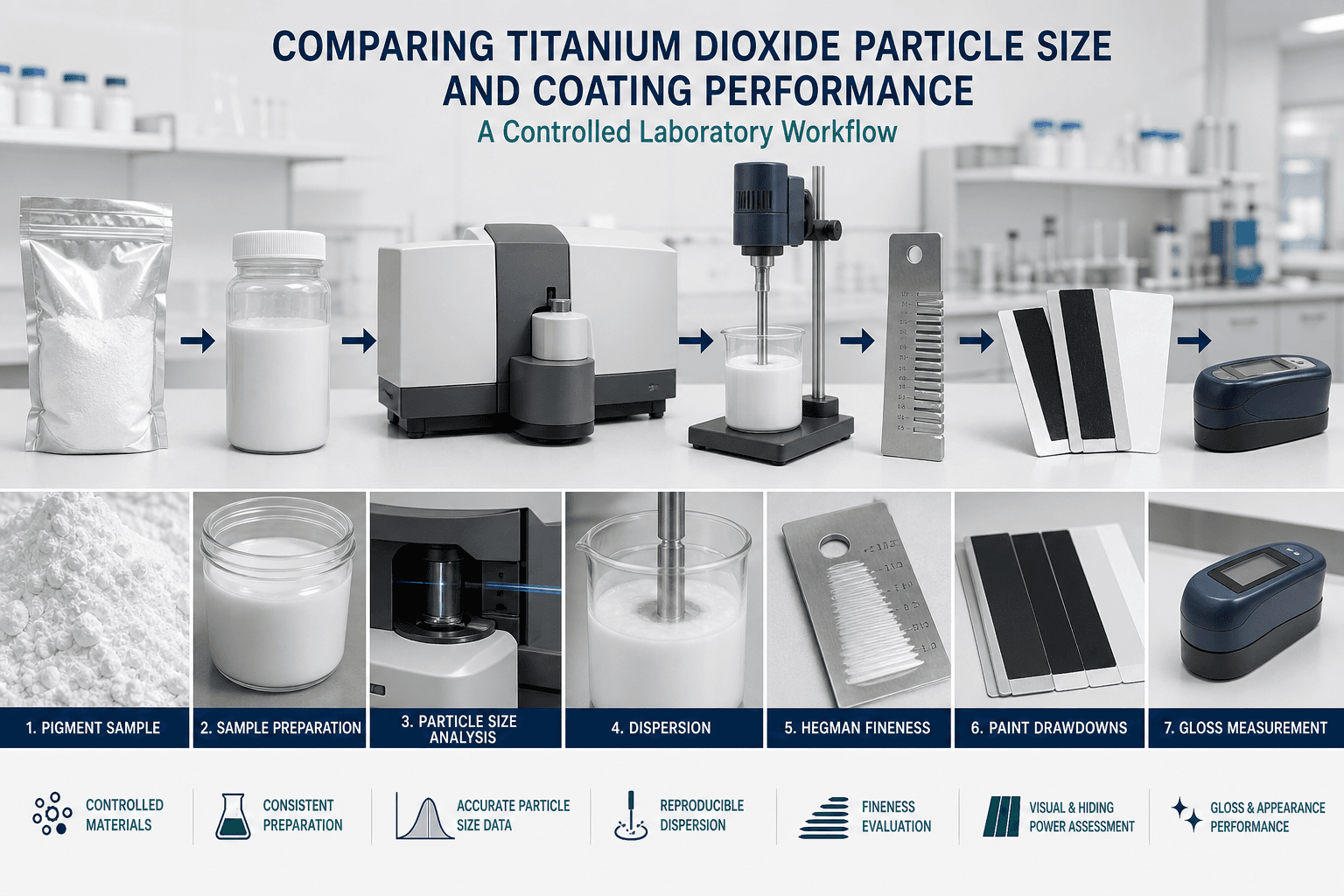
Particle-size data can support diagnosis, but it must be method-specific. ISO 13320 explains laser-diffraction particle-size analysis using an equivalent-sphere model. It does not guarantee dispersion in a customer’s formulation, so connect instrument data to screen residue, pressure, fineness, microscopy, or finished-product results as appropriate.
A Production-Relevant The Ink Formulation Trial
- Define the target product, control material, limits, and decision owner.
- Condition and identify every raw material; retain labeled samples.
- Run a laboratory screening with fixed equipment settings and recorded temperature.
- Measure the intermediate before downstream ingredients or processing can hide the cause.
- Produce finished specimens at controlled thickness, basis weight, geometry, or let-down ratio.
- Repeat critical tests and age samples under a relevant accelerated or storage condition.
- Scale up one controlled step at a time and document any line adjustment.
Do not approve this ink system from one visually attractive specimen. Repeatability matters because the largest commercial cost often comes from a narrow processing window, corrections, scrap, downtime, or customer shade claims. A production trial should confirm both average performance and tolerance to normal plant variation.
Troubleshooting Disappointing The White Ink System Results
Typical warning signs include poor transfer, pinholes, settling, weak adhesion, low coverage, or unstable press viscosity. Start by comparing the failing sample with the retained control under the same method. Then separate raw-material variation from formulation, equipment, environment, and measurement causes. Change one variable at a time; otherwise a successful correction will not reveal the real cause.
If dispersion or distribution is weak
Check charging order, wetting time, shear or mixing energy, temperature, moisture, dispersant compatibility, and the condition of screens or filters. More energy is not always the answer: excessive heat or residence time can damage the polymer, binder, additive, or surface treatment. Establish the stable the ink formulation processing window experimentally.
If appearance passes but durability fails
Review surface chemistry, stabilizer or binder protection, exposure conditions, specimen preparation, and film or part thickness. Initial whiteness and opacity are screening properties; they do not by themselves prove weathering, heat stability, adhesion, filtration behavior, or long-term mechanical integrity.
This Ink System Supplier Qualification Checklist
- Request a current specification and the method behind every acceptance value.
- Confirm the recommended application, processing window, dosage, and incompatible systems.
- Compare multiple production lots and keep approved retained samples.
- Define packaging, moisture protection, traceability, shelf life, and change notification.
- Calculate cost at the dosage and process conditions that actually pass.
- Agree on complaint evidence, response timing, and corrective-action expectations.
Longtai supports application-based screening for industrial pigments and mineral additives. Explore the titanium dioxide range, review titanium dioxide quality inspection, or contact the technical sales team with your base formulation, process, current control, and target properties.
FAQ
What evidence should support approval of Titanium Dioxide for Flexographic White Ink?
When evaluating film weight and coverage, check viscosity, print density, opacity, adhesion, rub resistance, and press stability. To keep this article’s decision process defensible, run the same ink formulation at controlled viscosity, film weight, drying conditions, and substrate. Define pass/fail limits before testing so a visually attractive sample does not outweigh processing stability or repeatability.
How should an unexpected result for film weight and coverage be investigated?
Compare the unexpected result with the retained control using the same method. Review viscosity, print density, opacity, adhesion, rub resistance, and press stability, then change one formulation or process variable at a time. Record the sample identity, lot, equipment settings, and measurement conditions before deciding whether film weight and coverage was affected by the material, process, or test.
Which measurements should be recorded when assessing film weight and coverage?
Record viscosity, print density, opacity, adhesion, rub resistance, and press stability, together with the sample identity, supplier lot, formulation version, equipment settings, test method, conditioning time, and raw measurements. For film weight and coverage, use the same units and measurement sequence for every candidate so differences can be traced to the material or process rather than the test setup.
When are the acceptance criteria for film weight and coverage ready for production use?
Approval should follow repeatable results from representative production material, not one successful laboratory specimen. Confirm that results for film weight and coverage remain acceptable inside the normal operating window, document any adjustment made during scale-up, and retain the approved control for incoming and complaint comparisons.
What supplier evidence is useful for film weight and coverage?
Request specification limits, declared test methods, representative lot data, traceability, packaging details, storage guidance, and change-notification practice. Match those documents to the plant checks for film weight and coverage; a typical value is useful for screening, but purchasing approval should rely on agreed limits and verified application results.
Need help planning a comparison? Send Longtai the intended application, formulation or process description, target specification, annual volume, and current problem. The team can recommend a starting grade and a focused the white ink system trial plan.
Technical reference: Official standards and test-method resources. Confirm the current edition and applicability with your laboratory or customer before setting a contractual limit.